
Table of Contents:
- Procurement Management System Meaning
- What Is The Procurement Cycle?
- Why Is The Procurement Cycle Important?
- Who Is Involved In The Procurement Process?
Procurement Management System Meaning
The procurement management system provides a solution for conducting centralized purchases based on demands submitted and approved by competent authorities. It provides businesses with a way to understand how they purchase their inventory at a reasonable price.
The procurement management system also provides an interface to initiate demands, which are approved electronically; after which, combined purchases are made, including receipt of approval, generation of FAX for multiple needs, generation of comparative statements, and preparation of purchase orders. Preparation of challans.

WHAT IS THE PROCUREMENT CYCLE?
The procurement cycle is a process that begins with establishing a justifiable need, through the development of the business case, competition, awarding and managing the contract, and preparing for what will happen once the contract expires.
The process does not end at contract expiry. As the contract is managed and service provided, the need should be reconsidered, and the business case amended and updated in preparation for the cessation of the current arrangements.
The cycle, suitably adjusted, applies to the procurement of supplies, works, and services.
The steps within the cycle are greatly simplified for lower-risk procurements, but the same decision-making processes should be applied.
WHY IS THE PROCUREMENT CYCLE IMPORTANT?
Procurement is often regarded as a narrow process of inviting bids and awarding contracts. The “cycle” approach to procurement ensures that the early steps in the process (development of the business case and options appraisal) and later steps (contract management, reviewing of future need, and exit strategies) are given the same emphasis as tendering and award.
The best value for money can only be achieved if all the steps in the cycle are carried out robustly.
The cycle also highlights the need to learn from earlier experiences to ensure continuous improvement.
WHO IS INVOLVED IN THE PROCUREMENT PROCESS?
Although this will vary from procurement to procurement, the key personnel who will be involved in the successful application of the procurement cycle will include:
- Those staff members assume project management roles: project owner, project manager, project board (if required), and project team roles.
- The contract or relationship manager.
- Trained procurement staff.
- Stakeholders such as users, existing suppliers, and the finance section.
- other professional advisers, including
- – accountants
- – legal advisers
- – technical advisers.
For higher-risk procurements, a wide range of people, from members and senior managers down, may be required to play an active and committed role.
CRITICAL SUCCESS FACTORS
The following points outline some key critical success factors in the management of the procurement process.
Key Points: Critical success factors
- Do not apply the procurement process in a mechanistic manner. Sound judgement, applied ethically and with a transparent audit trail, is essential.
- Project management, contract management, and a robust procurement process together increase the likelihood of success.
- Procurement should be recognised as a profession and carried out by skilled staff.
- The Gateway Process is an essential project management tool, particularly for high and medium-risk procurements.
APPLYING THE PROCUREMENT CYCLE IN THE PROCUREMENT PROCESS
Table 1 provides an outline of a generic procurement cycle and the steps that should be taken to achieve the expected benefits from the procurement. It should be noted that the principles of the procurement cycle apply to all procurements. However, the resources deployed for procurement should align with the project’s risks.
Risk/Value Matrix
Traditionally, within authorities, procurement processes have been determined by the contract’s financial value. Value bands have been set, with requirements falling into the lowest band only subject to quotation and higher-value requirements adopting progressively more demanding processes.
Value bands are a helpful guide and simple to apply. They do not, however, identify those procurements that may be of relatively low financial value but of a higher risk.
In addition to financial value, procurers should consider a range of risk factors when deciding on the resource levels and skills required, as well as the complexity of the processes to be applied.
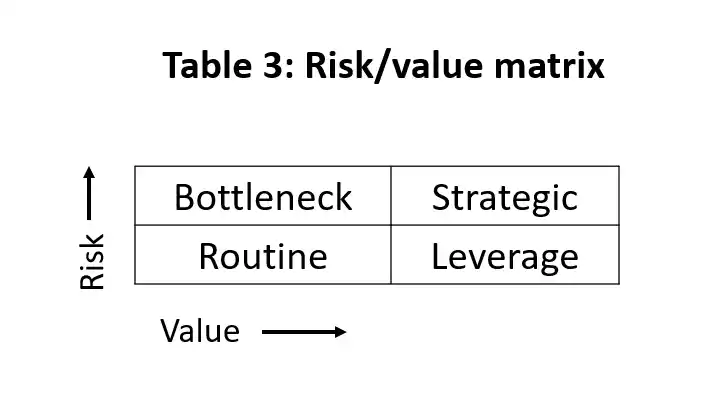
Table 3 below shows how procurements may be usefully segmented to identify the optimum level of resources to apply to the procurement project.
Risk and value have been used as the two leading indicators.
 Strategic Procurements
These are high-risk/high-value procurements that should be subject to a rigorous procurement process.
Routine Procurements
These lowest-risk/lowest-value procurements will include repetitive items such as stationery and ICT consumables. Although essential to the running of a modern office, their delivery should be carefully managed to ensure they do not consume a disproportionate share of procurement resources. They should be aggregated wherever possible.
Bottleneck and Leverage Procurements
Between the two extremes of Strategic and Routine procurements lies a range of procurements. These will require procurement processes that reflect the appropriate approach to ensure procurement is delivered on time and to budget, and to manage their value and risk levels. Authorities will need to consider which processes and offers best value for money.
IDENTIFYING RISK
There are two main types of risk to be taken into account when assessing the risk level of a particular procurement:
- Outcome risks, that is, negative impacts on the authority if it fails to deliver the requirement on time and to budget.
- Procurement risks-that is, those impacts that may cause the procurement to fail to deliver the requirement.
HIGH AND MEDIUM RISK PROCUREMENTS
Table 5 below repeats the stages of the Procurement Cycle at Table 1, but
highlights key activities at each stage. This is the process recommended for all high- and medium-risk procurements identified in the Project Assessment Spreadsheet (see above). Further information on each stage is provided below.
Following the procurement cycle outlined in Table 5 will increase the likelihood of successfully identifying the best value-for-money solution for the authority and provide a structured, standardised approach for undertaking a procurement.
No strategic procurement should be undertaken without specialist procurement advice.
Authorities undertaking a strategic procurement should refer to the 4ps website for further helpful information. Their focus is, in particular, large one-strategic procurements, but they will also provide for some of these, which are under development. procurement packs for areas such as
- Schools
- Social services
- Waste management
- Joint service centres
- Leisure
- Street lighting.
Given below are Key activities in the Procurement Cycle to be applied to strategic procurements
The Procurement Cycle
1. Define service need
- High-level business case
2. Develop the business case
- Undertake options appraisal
3. Define procurement approach
4. Supplier appraisal
- Advertise
- Assess applicants
5. Tender evaluation
Tendering exercise
- Bid clarification and post-tender negotiation.
6. Award and implement the contract
- Award contract
- Implement contract
- Debriefing
- Post implementation review.
7. Manage contract
8. Benefits evaluation (and return to beginning)
ETHICAL PROCUREMENT BEHAVIOUR
Authorities should set out the behaviour they expect of their members and staff in codes of conduct, and Contract and Financial Standing Orders. As well as providing minimum procedural requirements for procuring works, goods, and services, they will also provide the foundation for ethical procurement behaviour.
This section provides a guide to the main ethical procurement issues that authorities should ensure are reflected in their documentation.
Authorities should make it clear that any breach of these ethical standards may result in disciplinary action under the authority’s disciplinary process.
General Requirements
Ethics have been defined as rules of conduct which ensure that individual and organisations are trusted and respected by those with whom they ideal Ethical behaviour is of particular importance where public money is involved Additionally if a procurer’s behaviour is seen to be ethical they have a much so that the integrity of the public body and the public’s trust in it are maintained better chance of achieving a successful relationship with an ethical supplier.
Ethical behaviour can be embedded through awareness-raising, vigilance by managers at all levels, and the use of systems that minimise, as far as possible, the circumstances in which staff might be tempted to act unethically.
These systems also provide staff protection. If implemented fully and carefully, they will act as safeguards against accusations of impropriety levelled at staff by, e.g., suppliers, the public, and the European Commission.
Ethical procurement behaviour can be categorised under several headings, as shown below. Each of these is examined in turn, and the main principles and recommended actions are provided.
Disclosure of Interest
If staff have any personal interest in a supplier or potential supplier that may influence, or be seen to influence, their impartiality, they should disclose this to the authority. Such disclosure acts as an essential protection mechanism for staff.
Examples of situations where disclosure will be required include family or social ties with a supplier or prospective supplier, or a financial interest in the supplier’s organisation, such as owning shares or a family member owning shares.
Staff should at all times avoid situations that may lead to conflicts of interest or allegations of such.
Gifts and Hospitality
If officers are offered gifts or hospitality other than inexpensive seasonal stationery items or an occasional working lunch, the offer should be rejected and recorded in the authority’s Hospitality Register. Officers must avoid any situation that could give the appearance of being influenced by a supplier.
All accepted and rejected gifts and hospitality offers should be recorded by the member of staff in the Hospitality Register. The Register should be reviewed regularly to identify whether action may be required, e.g., where an officer accepts inappropriate gifts or has an excessive number of working lunches.
The Register should show the name of the officer, details of the supplier, details of the offer, its approximate value, and
whether or not it was accepted. Where there is any doubt about the propriety of accepting a gift or hospitality, it should be refused.
Confidentiality of Information
All information provided by suppliers should be treated as confidential. Information on tendered prices or innovative proposals could provide competitors with a commercial advantage and must never be used for personal gain. Leaks of such information could undermine the authority’s position when tendering and/or could be politically sensitive.
Fair Competition
Authorities should provide clear guidance on the procurement processes they require staff to implement. These should be based on competition.
Competitive processes are not only designed to deliver the best value for money for authorities but also to ensure that potential suppliers are treated fairly. Officers should be required to follow these procedures and to ensure that decision-making is transparent and recorded in detail.
Where an officer is under pressure to make a procurement decision that is contrary to fair competition, the authority should provide a mechanism for reporting it and for discreet handling.
Professionalism
Officers must always aim to project a professional image. This will include implementing the authority’s procurement procedures. Officers must also meet any contractual obligations they may have agreed to when the contract was awarded. Ethical behaviour during contract management will promote a trusting, non-adversarial relationship with suppliers, providing greater opportunities to work together and achieve better value for money for the authority.
Professionalism will be difficult without the necessary skills and experience. Authorities should ensure that staff are fully trained and implement any learning points from gateway reviews or project evaluation reports.
Responsibilities
Spending public money carries responsibilities and duties for staff at all levels.
Managers have the following responsibilities:
1. Setting an example by acting fairly and ethically and by following all guidelines and instructions. The actions and attitudes of managers are influential factors in shaping staff attitudes.
2. Presenting an open and approachable image which encourages staff to report unethical behaviour and which leaves them in no doubt that such matters will be dealt with confidentially and fairly.
3. Ensuring that instructions and guidelines are seen and understood, and providing training as required.
4. Supervising staff and ensuring that all staff are following the relevant instructions and guidelines and are retaining all pertinent information to provide a clear audit trail of the decision-making process,
5. Making every effort to ensure that no officer has conflicting roles that increase the opportunity for unethical behaviour, such as financial approval and payment authorisation.
6. Regularly rotating staff posts, every three years at least, to further reduce the opportunity for unacceptable relationships with suppliers.
Staff have a responsibility to follow all procedural guidelines, maintain records of the decision-making process for any procurement projects for which they have procurement responsibility to form a clear audit trail, and report any suspected unethical behaviour to management.
Summary
A procurement management system provides a solution for conducting centralized purchasing based on demands submitted and approved by competent authorities. The procurement cycle is a process that begins with establishing a justifiable need, through the development of a business case, competition, awarding and managing the contract, and preparing for what will happen once the contract expires. Strategic procurements are high-risk/high-value procurements that should be subject to a complete and rigorous procurement process.