
While morality refers to an individual’s personal compass of right and wrong learned from upbringing and beliefs, ethics refers to the external rules, professional codes of conduct, and guidelines provided by a group, organization, or society (e.g., Medical Ethics, Legal Ethics).
Difference between Ethics and Morality
Many people are unaware of the difference between morality and ethics, but a basic and important difference exists between them. Morality refers to an individual’s character, whereas ethics stresses an entire social system in which morality is practiced. It can also be said that ethics explain the codes of conduct of a group that an individual should adhere to.
Morality and ethics can come into conflict at the workplace. At the workplace, individuals’ morality may clash with the organisation’s ethics. For their greed, businesses sometimes put employees into difficult and demanding situations where they have to choose between challenging business ethics and their moral responsibility towards family, children, etc.
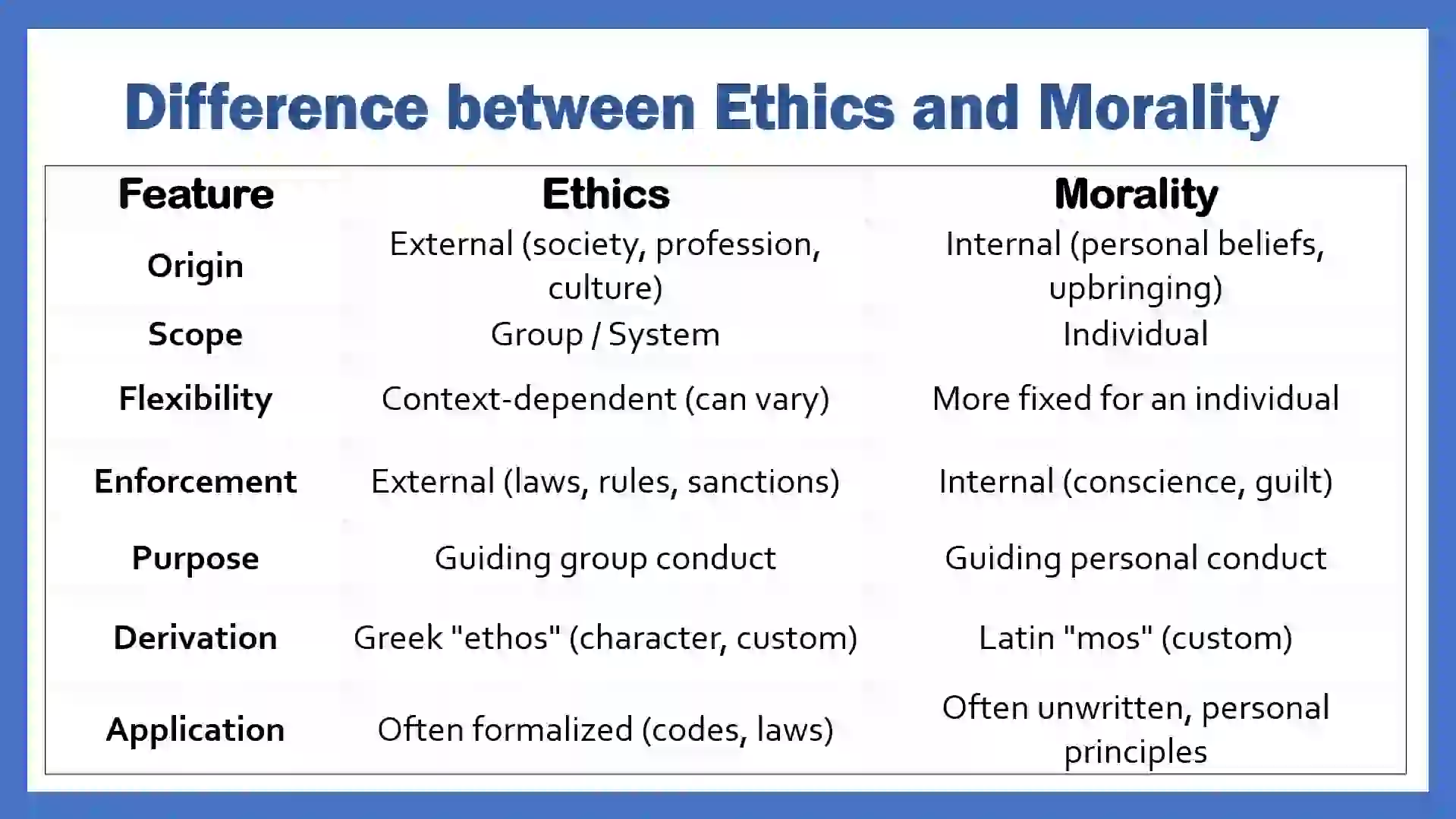
Points highlighting the differences between ethics and morals are described in the Table below:
Difference between Ethics and Morality
| Comparison Factor | Morality | Ethics |
| 1) Meaning | Personal beliefs & principles regarding what is right or wrong. | Systemic guidelines/rules set by a group, organization, or society. |
| 2) Root Word &Origin | Derived from Latin “Moralis” (customs). Internal (Originates within the individual). | Derived from Greek “Ethos” (character). External (Imposed by social/professional systems). |
|
3) Flexibility & Change |
Highly Consistent: Rarely changes unless an individual’s core beliefs shift. | Context-Based: Changes from one workplace, culture, or profession to another. |
| 4) Enforcement | Self-Enforced: Enforced through personal guilt, conscience, or self-respect. | System-Enforced: Enforced through legal penalties, fines, or termination of employment. |
| 5) Real-World Example | Believing that lying is fundamentally wrong under any circumstance. | A defense lawyer protecting a client’s confidentiality as per legal codes. |
| 6) Governing Body | Individual conscience, family upbringing, and personal faith. | Legal provisions, professional bodies, workplaces, and societal norms. |
💡 Real-World Conflict Example: The Defense Lawyer’s Dilemma
Imagine a defense attorney whose client confesses to a crime in private.
-
Personal Morality: The lawyer believes lying is morally wrong, and the criminal deserves punishment.
-
Professional Ethics: Legal ethics dictate that the lawyer must provide a fair defense and maintain attorney-client confidentiality.
-
The Result: Professional ethics override personal morality in the workplace.
Meaning of Morality
The word ‘moral’ is derived from the Latin word ‘moralis’, which pertains to the principles of right and wrong or good and bad. Morals refer to the standards that are set to evaluate the appropriateness and goodness of the personality or behavior of a person.
The values and beliefs that a person has innate into himself are said to be the morals of that person. Human beings do not require much time to make moral decisions, as the basis of such decisions is their deep-rooted values and beliefs. Hence, it can also be said that morals are reflex responses to the situation. The moral actions of human beings are based on their morals, which they have learned from their parents, friends, colleagues, teachers, situations, etc.
Definition of Morality
According to Ayn Rand, “Morality is a code of values to guide man’s choices and actions – the choices and actions that determine the purpose and the course of his life”.
As per Hegel, “Morality is an internalisation of values and external legal relations”.
According to Purtilo and Criss, “Morality is everyday behaviours that allow us to live successfully with one another. They include concepts like values (what we cherish) and duties (actions that we are required to do)”.
According to Max Weber, “Morality is the set of norms and values that dominate society at a certain moment in time/place”.
Characteristics of Morality
Morality or morals have the following characteristics:
1) Informal Execution: Morals are enforced informally. It is enforced either in the form of advice or in the form of lectures and scolding.
2) Time Scale: Morals are generally very deep-rooted in the history of society and religion, as they grow and develop over centuries and millennia. In the Western part of the world, beliefs of “Judeo-Christian” and the Old and New Testaments are prevalent; whereas in the Eastern part of the world, one can see the dominance of Islam and the Quran.
3) Voluntary: Morals are personal; even family members and friends may have differences in their moral decisions and actions. A person may be influenced by the moral opinions of others, but agreeing or disagreeing with them is up to him.
4) ‘Ought’ Concerns: In every society or community, people are persuaded or even forced to behave in a manner in which they ‘ought’ to be. Even a person with high moral values sometimes faces criticism related to these ‘ought’ issues.
Relationship between Ethics and Morality and Ethical Theory
There is a close relation in the original meaning of both, the Moral (moralis in Latin and the Ethics) (ethos in Greek). The meaning of both words is the custom or way of life. Morality, nowadays, refers to an individual’s behavior, while ethics, also known as moral philosophy, refers to the study of moral behaviour
A criterion of a person or a group regarding right and wrong or good and bad is known as morality.
Ethics is the study of morality, and it talks about the reasons that explain particular rules that help in deciding what is wrong or what is right in a given circumstance. These rules are known as ethical theories. The relationship established from this viewpoint is that morality is preceded by ethics, which is then preceded by ethical theories.
The relationship is illustrated in the figure provided below.
Morality and Ethics: Exploring Their Similarities and Effectiveness
Morality and ethics are both concerned with good, bad, right, wrong, etc., hence looking identical to each other. The activities, persons, decisions, etc., if considered moral, then they would also be considered right. Similarly, if any of them is considered immoral, then they would be considered wrong. It is also believed that the principles that a moral person follows are right and important.
A morally correct person will always stick to their principles, even if their interests are negatively affected by them. Such persons, if they lose any argument, court case, election, etc., do not deviate from their principles, and they are said to achieve a “moral victory”.
Such principles provide due respect to the right behaviour, and they are not only held by a person or two, but the society at large also considers them supreme. These principles are respected by the majority of people only because concerned persons get praise for their moral victory,
The principles that are respected and accepted by a majority of people are considered ‘moral.’ As per definitions and theoretical contexts, ethics and morals have some differences, but in all other cases, they may be considered similar.
What are Ethics?
The word “ethics” is extracted from the Greek word “ethos”, which refers to nature and guiding values. Principles or ideals that are spread through a group, community, or people. Every individual is responsible to their community for their actions. The community can exist in various forms, such as neighbourhood, profession, city, state, etc. Ethics serves as the guiding principle that distinguishes between good and bad, right and wrong, moral and immoral, just and unjust, and appropriate and improper actions of human beings. Thus, ethics means a code of conduct. It directs a person’s behaviour towards another person.
Ethics is necessary for human life. This is a way of deciding on a course of action. In the absence of it, the actions would be arbitrary and without any goal. There would be no manner of working towards an aim as there would be no way of choosing between a limitless number of aims. Even after following ethical standards, people may not be able to achieve their goals successfully. Only to the extent that a rational ethical standard is taken, people can organise their aims correctly and take actions to fulfil their significant values. Any defect in ethics will reduce an individual’s ability to succeed in his efforts.
Meaning of Ethics
Ethics is a group of norms or codes or value systems, devised from human reason and experience, through which free human actions are determined as right or wrong, good or malicious.
Definition of Ethics
According to Webster, “Ethics is the discipline dealing with what is good and bad and with moral duty and obligations”.
As per Josephson Institute, “Ethics is defined as standards of conduct that indicate how one should behave based on moral duties and virtues”.
According to Philip Wheel Wright, “Ethics is a branch of philosophy which is the systematic study of selective choice of the standards of right and wrong and by which it may be ultimately directed”.
Characteristics of Ethics
The characteristics of ethics are as follows:
1) The concept of ethics applies only to human beings because they have the freedom to choose and the means of free will. They can decide how they wish to pursue their goals and the means to achieve the ends.
2) There was a debate regarding the nature of ethics: was it a science, or was it an art? But the experts viewed ethics more as a science than an art. The reason behind this was that ethics is a systematic knowledge of the moral activities and behaviour of human beings.
3) Ethics is concerned with voluntary human behaviour that is not forced by the situations or by other human beings. It can be concluded that at the basic level, ethics involves moral judgment about fixed human behaviour.
4) Ethics is considered a normative science. It seeks a perfect and absolute test of right behaviour. Normative science involves deciding on moral standards that govern the conduct of good and evil.
Scope of Ethics
Ethics encompasses the study of all human actions, i.e., good or bad, just or unjust, beneficial or harmful. It studies the cause and effect of all human acts. What is the basis or cause of human acts? Human acts: Are they voluntary or forced? Are they caused by external or internal factors? Are they unconscious or deliberate?
For example, are they caused by societal compulsions (law) and practices, or driven by one’s conscience leading to happiness and benefit, or harm and punishment? Ethics also enquires into and investigates what constitutes human freedom, morals as determined by society, duties, obligations, etc. It is the study of all human behaviour against the backdrop of the values of society.
Understanding the Fundamentals and Practical Applications of Ethics
Ethics also focuses on the morality of human behaviour. What behaviour is good, and why is it good? Is it because the morals of society deem it to be so, or are there other higher metaphysical reasons? Are morals absolute and universal, or do they vary in time and space? Ethics does not lay down morals but rather studies them. It distinguishes between the inherent goodness of man and the goodness of his skills or knowledge.
Meta-ethics has dealt with the key concerns of Ethics or Moral Philosophy and Normative Ethics. Meta-ethics focuses on the moral aspects of a person’s thoughts, actions, and language, while Normative Ethics is judgmental in nature and scope and evaluates the norms or rules of what is considered right or wrong, good or bad.
When the principles of ethics are applied to day-to-day situations to judge and evaluate human acts, it is known as Applied Ethics. Depending on the field or area of its focus, we have Business Ethics, Medical Ethics, and Parliamentary Ethics. Legal Ethics and so on, which deals with subjects like abortion, profiteering (large unfair profit), use of money and muscle power in elections, child marriage, etc. Thus, Applied Ethics has an organic connection with all branches of human knowledge, life, and society.
4 Core Principles of Ethics
The basic principles that ethics seeks to propagate are as follows:
- Principle of Least Harm
- Justice and Fair Play
- The Principle of Doing Good or Beneficence
- Principle of Respect for Autonomy
1) Principle of Least Harm
This is an outcome of the beneficence principle. If you cannot ensure “good,” then minimise “bad,” or in other words, if you cannot ensure “pleasure,” then minimise “pain”. This is often reflected in a surgeon’s choice, e.g., to surgically remove a part to save the whole body.
2) Justice and Fair Play
This principle is another cornerstone of ethics. It implies that all actions must be fair and as per norms (rules, laws, etc.). For example, no one is allowed to take another person’s life. However, this, like other principles, is not absolute but tempered by emergency. For example, a soldier or a policeman is permitted to shoot and kill in the larger interest of the country’s defence or the interest of law and order.
3) Principle of Doing Good or Beneficence
This is the central principle of all ethics. It seeks to ensure the greatest good of the greatest number, ie, to first define and establish what constitutes “good” and then find ways and means of extending it to the largest number. An example is the medical ethics of making healthcare available to all, or the ethics of governance, which seeks to ensure basic amenities for all citizens. This is also the central principle of utilitarianism, which seeks to maximize overall happiness and well-being for the largest possible number of individuals.
4) Principle of Respect for Autonomy
Autonomy, or the freedom of every human being to choose his or her actions, is another central principle of ethics. It provides choice and respects human dignity. Also implicit in this principle is the element of trust, which implies that every human being can be trusted to take actions appropriate to his interests and well-being (without compromising the interests of others). Every individual is a rational being who knows what is best for himself and others. Hence, whatever he does would be appropriate and correct in his own and the larger interest.
This principle, however, has two viewpoints:
i) Paternalistic Viewpoint: Under this viewpoint, an authority usually helps the individual decide (dictates) based on what is considered to be in their best interest. For example, a cricketer may want to become a fast bowler, but his coach may decide on his becoming a spinner, based on an assessment of his abilities.
ii) Libertarian View: This is a liberal viewpoint that does not believe in interfering with the individual’s choices. The individual can be trusted to know what he thinks is best for him and to choose to act accordingly.
4 Main Types of Ethics
Ethics are classified into four broad types:
- Descriptive Ethics
- Normative Ethics
- Analytic Ethics
- Applied Ethics
1) Descriptive Ethics
Descriptive ethics, as the name suggests, observes and records in great detail the ethical behaviours in various cultures and societies, often over some time. The basic purpose of descriptive or comparative ethics is to enquire, observe, and record. The focus of its study is beliefs, practices, social and cultural institutions, value systems, aberrations, deviations, etc., and how they have evolved over time and/or how they are different from those of other societies or cultures. It has a close cross-functional relationship with the disciplines of History and sociology. Psychology and Anthropology, with whose help it seeks to conduct its enquiry.
It also seeks to answer the following questions
- What are the ethical norms, morals, or values of different cultures and societies?
- Why do people accept and validate these?
- How have they evolved?
- Why do people follow or abide by them?
- How do people resolve ethical dilemmas?
2) Normative or Prescriptive Ethics
Normative ethics focuses on norms or morals or accepted, legitimised practices as against behaviours. What is right and what is wrong? Why are certain actions considered good and others bad? What is the moral regime of a society? It is also judgmental in that it evaluates all answers to the above questions. Just as social and religious leaders in a society, the Church in the West, e.g., determines and oversees moral behaviours, similarly, every organisation also lays down acceptable behaviours through codes of conduct and rules and also ensures internal adherence. Such legitimised behaviours in society are further authorised and enforced through laws.
Normative ethics also seeks to do the following:
i) Establish and define what is good and what is bad, what is acceptable and what is not.
ii) Lays down the moral precepts or principles.
iii) Legitimises certain behaviours as moral.
iv) Establishes the authority structure for the enforcement of accepted or moral behaviour.
It is a well-known fact that every individual’s decisions and actions can affect morality. If the individual is working in an organisation, then his morality can affect the moral agency of the organisation. Normative or prescriptive ethics is a way of recognising all moral issues and formulating guidelines for solving them. Organisational leaders perform a vital role in creating and maintaining a congenial environment for effective moral agency.
3) Analytic Ethics
Analytic or Meta-ethics investigates and explores the status, foundations, and scope of moral values, properties, and words. It is essentially non-normative and rather focuses on analysing and understanding various facets of human acts, attitudes, prejudices, biases, judgements, etc. It does not focus on assessing particular choices like worse, better, bad, or good; instead, it enquires into the nature of morality and related issues and concepts. Analytic Ethics seeks to answer the following questions:
- Is morality absolute or objective?
- What is the relevance and importance of morality?
- The religion-morality mystery.
- The foundations and rationale of moral issues.
4) Applied Ethics
Applied Ethics, as the name suggests, is the application of various ethical theories and precepts to day-to-day situations. It draws heavily from disciplines of sociology, philosophy, anthropology, history, etc., and seeks to provide solutions to real-life problems and dilemmas. It is often used by lawmakers to determine public policy. Applied Ethics finds wide usage in professions like law, business, medicine, environmental conservation and protection, etc. It also sometimes assumes the nature of social reform, e.g., the movement against sex determination tests.
Thus, applied ethics is a practical branch of ethics, distinct from normative ethics, which focuses on what is right and wrong, and meta-ethics, which confines itself to the intrinsic nature of morality. As an emerging field, it typically works on the following six areas to improve social and professional life:
- Decision-Making: Decision ethics works on the ethics involved in decision-making processes.
- Professional Life: Professional ethics seeks to enhance the quality of professional life by making it more fair, equitable, and transparent.
- Health Care: Clinical or medical ethics seeks to improve the delivery and coverage of health care to all.
- Business Culture: Business ethics seeks to enhance the competitive space amongst organisations. It focuses on how businesses should deal with each other in a competitive environment.
- Organisational Culture: Organisational ethics seeks to improve the internal culture of the environment within organisations.
- Social and Global Life: Social ethics works on how to make the world a better place to live in. It works on issues and conflicts affecting societies and nations.
Frequently Asked Questions
FAQ 1: Can something be ethical but immoral?
Answer: Yes. For example, a defense attorney legally and ethically defending a known criminal is following professional ethics, even if their personal morality considers defending a criminal wrong.
FAQ 2: What is the main difference between ethics and morals in simple terms?
Answer: Morals are personal beliefs about right and wrong dictated by individual conscience, while ethics are external rules and standards set by a group, profession, or society.
FAQ 3: Are ethics more flexible than morality?
Answer: Yes. Ethics can change depending on the organization, jurisdiction, or profession you belong to. Morals, however, remain largely consistent across an individual’s lifetime.
About the Author:
Written by Arya, Assistant Professor in Management & PhD Scholar. Reviewed for academic accuracy and SEO standards.